


 [send private message], United States Project WikiTree [send private message], and Ethan Lima [send private message]
| Robert Frost is a part of United States history. Join: United States Project Discuss: united_states |
Contents |

Robert Frost was born on 26 March 1874 in San Francisco, California.
His mother, Isabelle (Moodie) Frost, was of Scottish descent; his father William descended from colonist Nicholas Frost from Tiverton, Devon, England who had sailed to New Hampshire in 1634.
Robert's family were Swedenborgians, and he was raised in that religious tradition, but did not remain as an adult. He wrote: “I was brought up a Swedenborgian. I am not a Swedenborgian now. But there’s a good deal of it that’s left with me. I’m a mystic. I believe in symbols.”[1]
William had hoped that Robert would become an editor in San Francisco, like William was. However, when William died in 1885 the family moved east back to Lawrence, Massachusetts.
Frost's first poem was published in his high school newspaper.
After graduating from high school, Frost attended Dartmouth College. He returned home to teach and work various labor jobs. He hated these jobs and felt his true calling was poetry.
Although he is known for his rural poetry, Frost spent his childhood in the city.
Frost's first paid poem was My Butterfly: An Elegy, published on 8 November 1894. He received $15 for the poem.
He soon proposed to Elinor Miriam White, who said she first wanted to finish college. Frost, a bit dismayed, traveled to the Great Dismal Swamp in Virginia and, upon his return, asked Elinor again. This time, she agreed.
Frost then went on to attend classes at Harvard for two years, where he did very well.
His grandfather purchased a farm for the couple in Derry, New Hampshire. Frost worked the farm for nine years while he wrote many of the poems which would later make him so famous.
He was unsuccessful as a farmer and returned to teaching English at Pinkerton Academy from 1906 to 1911.
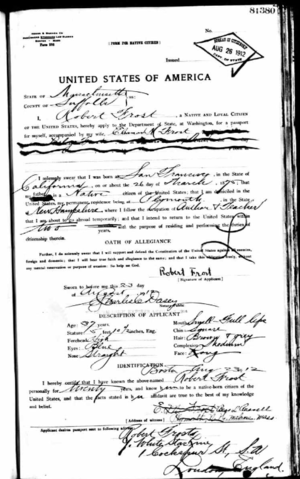
In 1912, Frost took his family to Great Britain and settled in Beaconsfield, near London. His first book of poetry, A Boy's Will, was published only a year later.
A Boy's Will includes the poems Into My Own, My November Guest, Stars, To the Thawing Wind, A Prayer in Spring, Flower-Gathering, Rose Pogonias, A Dream Pang, In Neglect, The Vantage Point, Mowing, Going For Water, Revelation, The Tuft of Flowers, The Demiurge's Laugh, Now Close the Windows, In Hardwood Groves, October, Reluctance, The Trial by Existence, Pan With Us, A Line-Storm Song, My Butterfly, Ghost House, Love and A Question.
Some of Frost's most memorable work was written while he was in England.
Frost returned to America in 1915 when World War I began. He purchased a farm in Franconia, New Hampshire and launched his career in writing. This home would serve as his summer home until 1938 and it is maintained even today as "The Frost Place", a museum and poetry conference site. However, in 1920 he moved from New Hampshire to Vermont. His stated reason was "to seek a better place to farm and especially grow apples."
Frost also spent a great deal of time teaching at many schools an universities. He emphasized public speaking and the voice used when reciting poetry.
Although Frost's poems are beautiful, his life was filled with grief and loss. When his father died of tuberculosis in 1885, the family was left with only $8. His mother died of cancer in 1900. Also in 1900, Frost's son Elliot died of cholera before his 4th birthday. In June, 1907, his daughter Elinor died shortly after her birth. In 1920, Frost committed his younger sister, Jeanie, to a mental institution. She would die only 9 years later. Frost himself suffered from depression, something which ran in his family. His son, Carol, committed suicide in 1940 at age 38. Frost would have to commit another loved one to a mental hospital in 1947 when his daughter Irma succumbed to schizophrenia. Frost's wife, in addition to suffering from depression, developed breast cancer in 1937 and died of heart failure in 1938. Of their six children, only daughters Lesley and Irma outlived their father.
Robert Frost died on January 29, 1963, in Boston, of complications from prostate surgery. He was buried at the Old Bennington Cemetery in Bennington, Vermont. The epitaph on his gravestone reads, "I had a lover's quarrel with the world."
Robert Frost planned to recite a poem at the inauguration of president John F. Kennedy. He called the poem Dedication.
Robert Frost was 87 at the time. He claimed that the bad glare from the sun prevented him from reading his poem. He stumbled over his words and his flow was off due to his unfamiliarity with the poem. He quickly gave up and instead recited The Gift Outright.
President Kennedy honors Robert Frost for literary contributions on poet's 88th birthday last March. [2]
Source Citation: Year: 1928; Arrival: New York, New York; Microfilm Serial: T715, 1897-1957; Microfilm Roll: Roll 4386; Line: 22; Page Number: 161. Source Information:Ancestry.com. New York, Passenger Lists, 1820-1957 [database on-line]. Provo, UT, USA: Ancestry.com Operations, Inc., 2010.
Nation Mourns Passing of Robert Frost[4]
 Login to collaborate or comment, or contact
a profile manager, or ask our community of genealogists a question.
Login to collaborate or comment, or contact
a profile manager, or ask our community of genealogists a question. ~25.00%
Douglas Wilber
~25.00%
Douglas Wilber  :
23andMe
:
23andMe
Have you taken a DNA test? If so, login to add it. If not, see our friends at Ancestry DNA.
Robert is 14 degrees from Emeril Lagasse, 21 degrees from Nigella Lawson, 24 degrees from Maggie Beer, 43 degrees from Mary Hunnings, 26 degrees from Joop Braakhekke, 26 degrees from Michael Chow, 21 degrees from Ree Drummond, 22 degrees from Paul Hollywood, 22 degrees from Matty Matheson, 24 degrees from Martha Stewart, 29 degrees from Danny Trejo and 24 degrees from Molly Yeh on our single family tree. Login to find your connection.




William Prescott Frost was Robert Frost's grandson. He and his family lived in Panama City, Florida as part of Bill's career as a naval architect. Robert "Bob" Frost (1952-2011) was his son and a professor at the University of Michigan. William Prescott Frost had one other son, but not one named "Bill."