

 Loading...
| John Ericsson is managed by the Sweden Project. Join: Sweden Project Discuss: sweden |

Contents |
Biography

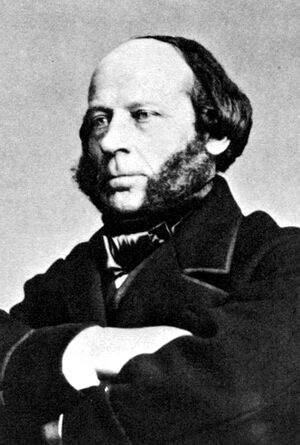
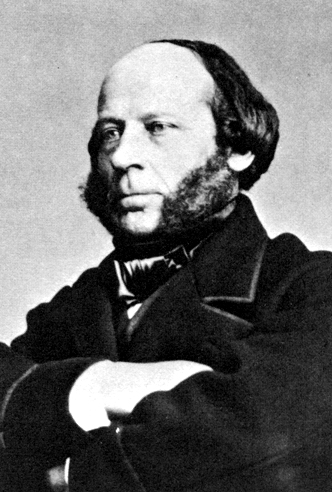
John Ericsson might be best remembered as the designer of the ironclad ship USS Monitor.
Although none of his inventions created any large industries, he is regarded as one of the most influential mechanical engineers ever. Some of his notable inventions were:
- The surface condenser
- The hot air engine
- The world's first monitor-class (turreted) ship, USS Monitor, was both designed and built by Ericsson for the Union Navy during the US Civil War
- Torpedo technology, especially destroyer torpedo technology, an advanced torpedo boat
- The solar machine, using concave mirrors to gather solar radiation strong enough to run an engine.
- The screw propeller and other inventions for the USS Princeton (1843)
- Improved hoop gun construction
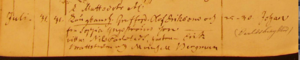
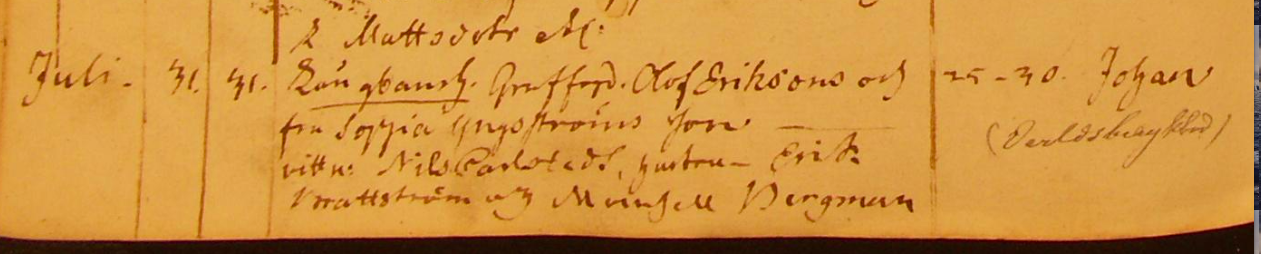
Johan Ericsson was born in Långbanshyttan, Färnebo parish 31 July 1803 and was christened on the same day. His parents are listed as "Gruvfogden" Olof Eriksson and his wife Sofia Yngström. [1] He was the youngest of three siblings.
His father's occupation was "gruvfogde" (mine foreman) and he worked at a mine in Värmland named Långbanshyttan. But when the mine's iron deposits dried up and there were no longer profits to make, Johan was born. His indebted father resigned from his post.
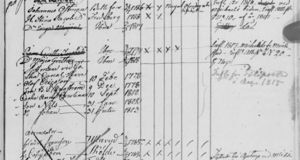
The family remained in Värmland, and his father remained working in mining industry, but the family was now poor. When his father lost his job at Gustafsgruvorna in 1809, due to war, the family left Värmland for Forsvik, Västergötland. His father worked there on blasting for construction of Göta Canal. The minister that kept the books for the canal would later comment that Johan Blef en af verldens namnkunigaste män igenom sina många uppfinningar (Johan became one of the world's most famous men through his many inventions). [2]
Johan and his brother Nils, who both seem to have an aptitude for mechanics and mechanical inventions, now found themselves in an inspiring environment. They became students at the canal-building office and Johan became acclaimed for his cartography and alike. He had a special ability to draw well and beautifully. When it came to maps and engineering drawings, you could almost say that they were artistic.
A German engineer, A. Pentz, hired for the canal building, gave Johan a thorough training in planimetry and geometry. As a result, at age 14, Johan became an assistant leveler, to which he succeeded so well that in 1816 he was allowed to work independently as a leveler.
Johan lost his father in 1818 and in 1821 he joined the military in Jämtland. During this time he graduated as a surveyor. As an engineer and inventor he suggested improvements to weapons, but he was met with distrust.
In Jämtland, he fell in love with Caroline, the daughter of Captain Jacob Lilliesköld. They never married, but they did have a son, Hjalmar Elworth, born 16 Nov 1824.
In May 1825 he was granted leave from military service, which allowed him to travel to England. He would remain there until 1839, mostly in London. He continued his experimenting and inventing, which now had to be self-financed. Among with many other inventions, he constructed a portable steam fire extinguisher which proved its value in a large London fire in 1830. He also took part in a competition to build a locomotive, in cooperation with English engineer John Braithwaite, which resulted in building the locomotive Novelty.
On 16 October 1836, he was married in St. Johns church, London, to Amelia Byam, granddaughter of Sir Charles Byam. At this time John was employed by Eastern Counties Railway.
John then left England for United States, arriving in New York City on November 1839. His wife joined him there, but in 1840 moved back to England while John remained in the US. They never divorced, but they lived separately and never had any children. Amelia died summer of 1867 in London.
Soon after his arrival in New York City, John met the industrialist Cornelius Henry DeLamater, who owned DeLamater Iron Works. They developed a close friendship that lasted until their deaths. DeLamater built many of John Ericsson's inventions.
In the beginning, John had financial difficulties in the US. He continued with his inventions and experimenting, but not much had paid off and he was cheated out of most of his payments for his work on the USS Princeton.
Eventually, though, his patents gave him some income, along with occasional large payments, but his experiments and inventions also cost large amounts of money. It was not until his hot air engine, patented in 1855, and improved on up to 1858, that he became permanently financially stable.
Not only did his finances improve, but so did his reputation. The pinnacle of which was reached with his work on the USS Monitor, for which he became famous.
Among other awards, John was the second to receive the American Rumford medal. In 1867 he received the Swedish Commander Grand Cross from the Order of the North Star (Nordstjärneorden). In 1877 he was elected a member of the American Philosophical Society. For his work, he received an honorary doctorate from Linköping University, and was elected to The Royal Swedish Academy of Sciences (Kungliga Vetenskapsakademien).
In New York City, he lived at 95 Franklin Street, from 1843 to 1864, then moved to 36 Beach Street, which was his final residence. Although he was not a theoretically-trained scientist, he set up an observatory on his roof terrace for experiments regarding solar heat radiation and reflexive moon radiation.
John suffered from a kidney disease, then called Bright's disease, which seemed to been the cause of death. The death of his dear friend DeLamater just a month earlier may also have contributed to his death. He died in his home, 86 years old, on 8 March 1889 and the funeral took place on the 11th in Trinity Church, New York City.
Reinterment in Sweden
Even though John become an American citizen in 1848 he expressed a definite desire to rest in Swedish soil. The United States Government honored his request by making the armored cruiser USS Baltimore available for the transfer of his body to Sweden. John's coffin was wrapped in the star-spangled banner, with the Swedish flag next to it. Onboard the ship, serving as John's escort, was Admiral Worden, USS Monitor's First Commander. When the USS Baltimore, escorted by other ships, departed New York on 23 August 1890, it was saluted with a twenty-one gun salute and the Swedish flag hoisted on every escort ship.
Upon arrival of the party in Sweden, Sunday, 14 Sept. 1890, John's coffin was received with great honors in Stockholm. The coffin was brought ashore and, in procession, the coffin was taken to Stockholm Central Station. An extra train was waiting there to escore it to Filipstad. More than 100,000 people gathered on the streets to view the procession, led by Svea Life Guards (Svea Livgarde), with every church in Stockholm were ringing their bells.
The escort train, with an open hearse train car that was stately decorated in black velvet with silver embroidery and tassels, arrived in Filipstad the following day. There, the Bishop of Karlstad performed the funeral service. Finally, John Ericsson had returned to Värmland, for the first time since he left Sweden in 1826.
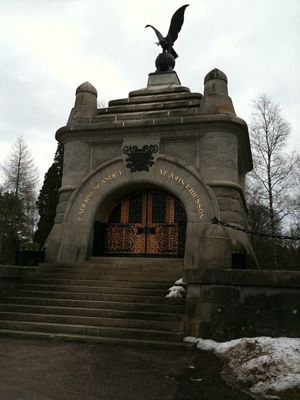
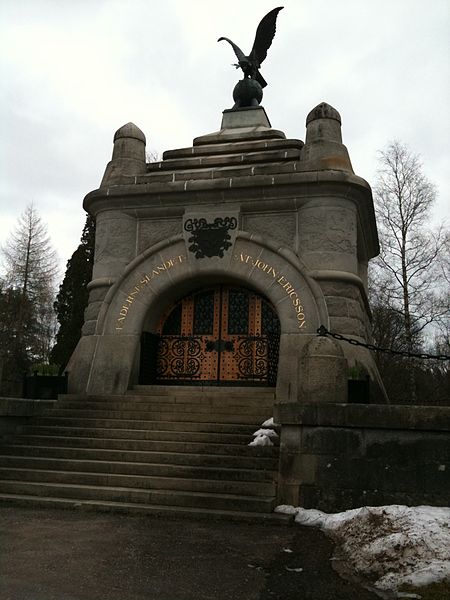
In 1895, the temporary burial chapel for him was replaced by the current mausoleum, built by huge granite blocks and inaugurated on John's birthday on 31 July 1895. Chiseled above its entrance arch is the inscription "Fäderneslandet åt John Ericsson" (The Fatherland to John Ericsson).

|
| Grave in Filipstad, Sweden Picture from Wikicommon |
Research Notes
Old bio mentioned him being in prison 1832?
John Ericsson had, in his own name, about 500 patents registered at the time of his death. It is not realistic to mention all of his inventions in this biography, nor to mention every detail of his life. If you would like any information added to the biography, please consult with the project managing this profile before doing significant edits.
Sources
- ↑ Filipstads kyrkoarkiv, Födelse- och dopböcker, SE/VA/13110/C/7 (1779-1809), bildid: C0037087_00226, sida 409.
- ↑ Färnebo (S) AI:12a (1807-1811) Bild 40 / sid 66 (AID: v11111.b40.s66, NAD: SE/VA/13146
- Filipstad (S) C:7 (1779-1809) Image 208 / page 409 (AID: v5799.b208.s409, NAD: SE/VA/13110)
- Färnebo (S) AI:11a (1799-1806) Image 67 / page 4 (AID: v11109.b67.s4, NAD: SE/VA/13146)
- Färnebo (S) AI:12a (1807-1811) Image 40 / page 66 (AID: v11111.b40.s66, NAD: SE/VA/13146)
See also;
- Långban Gruvhistoria Sweden Wikipedia article
- Wikipedia:John_Ericsson
- John Ericsson Sweden Wikipedia article
- This WikiTree profile is referenced from Wikidata: Item Q435290, en:Wikipedia

- John Ericsson on Find A Grave: Memorial #20123 Reinternment burial site in Filipstad, Sweden
- John Ericsson on Find A Grave: Memorial #10314 Original burial site in New York City
- John Ericsson, Svenskt Biografiskt Lexikon: #15375
- Mentioned in SBL article of his son Hjalmar Elworth, Svenskt Biografiskt Lexikon: #16050
See also:
- John Ericsson gården where he was born
- Ancestors of John Ericsson, the famous inventor. Formerly published in the book "24 Famous Swedish Americans and their Ancestors" (1996)], Rötterarkivet
- Witting, Victor and Betlehems-Stjernan, John Ericson article in "Illustrerad christlig kalender för 1890" (Worcester, Mass.: 1889) pp. 44-47
- Civil War Times Illustrated (July 1981), page 12.
- FamilySearch Person: MDNQ-2ZR