Loading...


 Loading...
Contents |
Biography

Cornelis was baptised in 1786 in Midwoud, he married Pietertje Gerrits Hasselman (1794-1866) in 1812 and died in 1879 at 93 years of age.
Children: Neeltje (Sept 29 1813), Gerrit (1815), Geertje (Feb 18 1817), Jan (Feb 7 1819), Trijntje (April 13 1821), Cornelis (June 29 1823), Jacob (June 3 1825), Klaas (Jan 30 1827), Dirk (May 8 1829), Pieter (June 30 1830), Arien (Aug 4 1831), Simon (June 19 1834), Willem (Feb 21 1840).
Cornelis was a farm laborer and later a transporter. On his marriage record he’s listed as a cow farmer (koeboer). Since his parents died when he was young, their farm was sold. And he didn’t inherit his uncle Jan’s farm either: it probably went to the descendants of his stepson. That left Cornelis with no farm, so he was hired by farm owners to help them farm. This is why he also lived in many different places – no farm ownership also meant he had to rent every house he lived in. Cornelis and Pietertje were married in Andijk in 1812 (their witness was Cornelis Singer, age 36, a cousin of Cornelis’). They may have been married only by the civil authorities since about this time they left the Hervormde Kerk (the official Reformed church) and joined a small church group called the Mazereeuwers. Consequently there are no baptism records of any of their children. We do have approximate years and towns for their births, though, and through them we know that Cornelis and Pietertje lived in Andijk for the first 7 years (at least until 1819), then in Hoogwoud until about 1831 (about 11 years), then in Heiloo until around 1842, then in Enkhuizen.
Cornelis' oldest daughter married Pieter Jansz Vriend, the leader of the Mazereeuwers in Andijk as his second wife. Two of Cornelis' other children married two of Pieter's children by his first wife. This kind of thing happened regularly among the Mazereeuwers since there were so few of them. The friendship between the descendants of Cornelis Sluys and Pieter Vriend continued into the next several generations, even into Canada in the late 1900's. The Vriend family of Andijk is descended from Jan Nicolaas Vriend (Freund) born in Hanover, Germany in 1728.
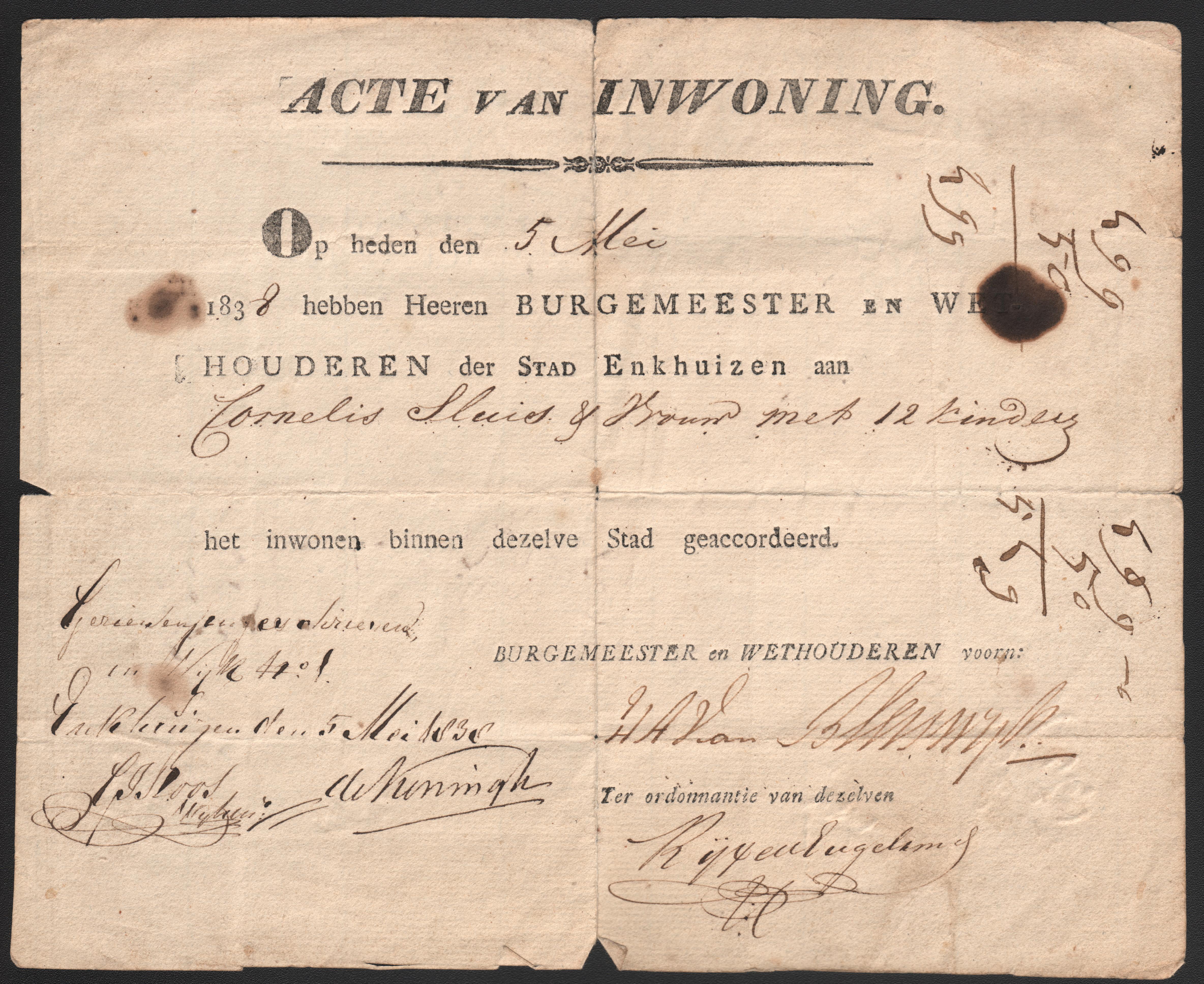
Cornelis’ home in Enkhuizen was at Westeinde 5/47 N K. For a short time – from July 21 1873 until April 29 1875 – Cornelis lived with his son Gerrit and his wife Aaltje Baan in Opperdoes. Then he moved back to Enkhuizen where he moved in with his son Arien.
Vrije Westfriezen Stories
Notes summarized by Bertram Sluys from the novel “Vrije Westfriezen I” by Cornelis Gerritsz Sluys: (see notes under Cornelis’great grandfather). “Vrije Westfriezen II” starts about 1800, covering the lives of the 4th Cornelis Cornelisz Sluijs and his sons and grandsons.
Chapter 1. April 24, 1807: The king is coming to Wervershoof! A few years before Napoleon Bonaparte had sent his brother Lodewijk (Louis in French) to be the king of the Netherlands. The Dutch people didn’t want this: if they were going to have a king, they wanted him to be William VI, prince of Orange. But for this day, many people come to Wervershoof to see the king, the young boys Jan and Cornelis Sluys included. Their uncle Jan stays home: he doen’t like these kinds of things. He and Grietje are quite concerned about the boys. Aagje, his step-daughter/step-granddaughter, had helped raise them a lot in the last 15 years, but now she is married to Jacob Mooy.And Jacob’s philosophy is you only live once, so you might as well live it up while you’re young. On the way they join some friends and stop at a tavern to drink too much alcohol. They then stop along the road and watch the French royal procession go by before returning to the tavern and causing more trouble.
Chapter 2. Grietje’s father Pieter Best never really liked their marriage, so when he dies he lavest his inheritance to Grietje and her children by Willem Kooiman, but nothing to Jan. Today Jan takes his boat out to do some work with his nephew Crelis, and they go to Bovencarspel together to visit Jan’s friend Gerrit Hasselman, a carpenter, to get some poles and fence rails. Gerrit helps them load a bunch of wood into the boat, and they then wait in the kitchien while Gerrit’s wife made them a nice dinner of potatoes and buttermilk porridge. Pietertje, Gerrit’s daughter, teases young Cornelis as she prepares food, and this gets him interested in getting to know her. She says she’s only twelve years old, but Cornelis finds that hard to believe.
Chapter 3. The first known enforced military conscription happened in 1799, under Napoleon. Many men from this time on are marked as a "schutter" (shooter or marksman) in marriage records; this would indicate they were soldiers. May 1812: Young Crelis is fortunate that he was born in 1786. Napoleon has called all boys born between 1788 and 1790 to enlist in his army. Cornilis’ brother Jan is one of those. If Jan had been born one year later, he’d have been sent on that disastrous invasion on Russia. So Jan isn’t around on this day, when Cornelis is getting married. Pietertje Hasselman is 17, far too young to get married, her father thinks. But he agreed to it when he found out Crelis didn’t need to become a soldier. Several neighbors are there today to prepare things for the wedding including Jacob Ellerbroek, a supervisor, who has nine children by his first wife, and is now married to the widow of Jacob Kooiman, who she had had eighteen children with. [This was Maartje Tensen, and Jacob and Maartje had one child together named Jacob. Some of Jacob's grandchildren married some of Cornelis' children.] Pietertje is a little put out that they have to get married by the burgemeester (mayor) Kees Veer instead of in church by Dominee Van den Burg. But the laws had changed under Napoleon. They now need a witness who is registered with the government. So they get married twice: in the burgemeester’s office and the church for the religious ceremony. Afterwards several of the men are deep in conversation about how Napoleon’s war is going in Russia, and Jacob Ellerbroek mentions that several French generals are on their way here to look for a deserter of the army named Jan Kalmijn. It turns out Cornelis’ uncle Jan is one of several local farmers hiding Jan Kalmijn. Jan's and Cornelis' stepsister Aagje Kooiman married Jacob Mooy who was more interested in taverns and a good time than catechism classes. In fact, it seems there were several taverns in Wervershoof and Andijk, and many men in the area had started to frequent them. They had names like "Krimper", which lets you know where it was. Jan Sluys and Grietje Best were very happy together. Jan managed Aagt's farm for the first 20 years, then became the owner of it. Willem Kooiman's children with Aagt: Mary married Teunis Vlam; Lysbeth married Johannes Sjerps and had a birding cote. Reinder married 2 Grietje. Foster child Dirk Kooiman was well educated, prosperous, and married to Antje Klomp. Jacob Pieters Mantel married Aafje Bakker. He was called "Cow Bub" because he raised cows. One of his sons married a daughter of Jan Groen. He was called "Turnip Bub" because he raised turnips.
Chapter 4. Jan Kalmijn grew up on the islands of Zeeland. He is one of those trying to help bring Willem VI back to Holland as King Willem I. Jan Sluys (and Jan Kalmijn’s father) see hiding him as needing to obey God before his government, in this case Napoleon who he considers to be the Antichrist.
Chapter 5. August 1812: Young Jan Sluys is now in Napoleon’s army. Jan’s first letter home includes information about his trip from Hoorn to Leiden. It really helps to know some French. He is assigned to the 17th military division, 2nd brigade, 3rd cohort. His captain is Frederiks and the leader of his cohort Hubner. He is expected to pay for his uniform and asks his uncle for fifty guilders. Another person had helped him get the rest. Oom Jan sends the money. He also explained in his letter that Burgemeester Veer had to find a way to lodge the soldiers in Andijk at his own expense, and that they were ordered to celebrate a victory of the French over the Russians at church. Jan’s brother Cornelis also writes him, carefully wording the letter as it would be read by French eyes before Jan could read it. He mentions that Geertje Groot is looking very under the weather. Jan should marry her as soon as he gets home! Jan, still in the Netherlands, discovers that he can hire a replacement to be in the army for him. All he has to do is pay 200 guilders for this service, plus be responsible for him in case he deserts. Jan found Jan van Eek from Utrecht to replace him. Dirk Groot was also known as Baas Hamer because he was a carpenter and contractor and he ran around with a hammer in his hand. (around 1825). He married Aagje Kooiman.
Chapter 6. July 1820: Cornelis Sluys comes to see Dominee Van den Berg to tell him his uncle Jan is at home very sick, and that they are now expecting their 4th child. So far all of the children have been in very good health. The dominee tells Crelis he has a lot to be thankful for with his uncle. For one thing, his influence has helped put Crelis on a Godly path. He was going in a rather worldly direction, but now he’s even been nominated to be an elder in the church! Napoleon is now languishing on the island of St. Helena, and the Netherlands is free once again. Synod is reorganizing the church, but not always in a good way. Now Dominee Van den Berg goes to visit Jan Sluys. Jan tells him he sees big danger in the Church - there are many liberal elements creeping in. The dominee assures it’s all in God’s hands. So Jan dies, and time passes. Crelis now lives in Hoogwoud on a farm he bought with three thousand guilders Oom Jan had left him. But now things are going poorly for farmers. The churches of the area, especially Andijk, don’t seem to be following God’s way. He decides it’s time to visit brother Jan, now a deacon in the Andijk church, for another talk. As he and Pietertje ride through Andijk that Sunday, he discovers a lot of people doing work on the Lord’s day. Not good! He arrives at Jan’s house to discover that the prophet, Jan Mazereeuw from Opperdoes, is there giving a service. Several people are gathered there including the younger Jacob Ellerbroek, Jan Kalmijn (now called Piet Veen) and the Groot and Vriend families involved with the new wildly successful seed business. Mazereeuw preaches a sermon from the book of Daniel. He explains that Daniel saw two men standing on the other side of the river: one was John the Baptist and the other himself. It’s time for the church to turn back to God. Crelis isn’t convinced this new “church upstart” is such a good idea.
Chapter 7. 1830: Jan Kalmijn marries Nanne Groot’s daughter: Nanne is one of the owners of the new seed company. But things aren’t going so well in the Netherlands: part of the Netherlands is declaring itself its own country called Belgium. Several young men from West Friesland are fighting in the war, including Wouter Groot, son of Nanne. He talks with Klaas Zwier from Opperdoes about Neeltje Sluys, daughter of Cornelis [It turns out he married her; in fact many of Cornelis’ older children married people from Opperdoes, and these were all people in Mazereeuw’s group].
Cornelis inherited quite a bit of money from Uncle Jan when he died. It helped him buy a house in Hoogwoud for his growing family around 1820 for 13,000 guilders. As the Reformed churches became more poorly disciplined - pastors stealing, deacons getting drunk on leftover Communion wine, farmers working on Sunday, strange teachings from the pulpit - Cornelis stopped having his children baptized and started following Mazereew's beliefs. However, his family is far from Opperdoes and Andijk, so they don't get his teaching every Sunday.
Chapter 8. Something disastrous seems to be looming. Three years ago a cholera epidemic had struck West Friesland, and this year Halley’s comet had flown by which superstition said caused terrible things to follow. Oom Jan had told Crelis and Jan that this fear didn’t fit in with what God does so we don’t need to be afraid of it. One Sunday morning in 1825, Cornelis and Piet decided to go to Andijk to church to see brother Jan. It so happened that the prophet Jan Mazereeuw was preaching at Jan's house that morning. People such as Jacob Ellerbroek Jr. and a rough young man, Nanne Robbert, were there. Mazereeuw announced himself to be the 2nd prophet in the book of Daniel, the first being John the Baptist. The "time" of the church was now past, and people were to follow him! Now Cornelis and Jan are meeting with Jan Schuurman from Medemblik. He tells them that this Mazereeuwer house group they’re attending instead of church is just a family affair: the seed handlers and most of the others are married to daughters of Nanne Groot. Jan is quite offended. Jan now starts to home school his children since he believes the school teacher in Andijk doesn’t teach God’s truths. And now another group of people, led by Jan Kalmijn, are also breaking away from the Reformed church: two splinter groups in Andijk! And Dominee Van der Zee tries to take legal action against both of them.
Around 1832, Cornelis couldn't make payments on his house in Hoogwoud anymore. The widow who owned the mortgage made his required payments too high after being scared that Belgium would win the war that was being fought. Mr. Van Foreest’s rentmeester (steward) offered Cornelis a home in Heilo for quite a high price, but only because a horse he had was well known for its hard work. Mr. Van Foreest was going to buy if for a good sum of money. But then it broke its leg, and Cornelis got almost nothing for it. Since the war with Belgium scared off other renters, Cornelis ended up getting getting after all. And he was a good farmer and was sought after. After the war the economy improved, prices for crops went up and Crelis started making some money off the farm. Then Mr. Van Foreest's steward wanted Cornelis gone when someone else offered him more money for the farm. He looked for ways to get rid of Cornelis. He gave Cornelis permission to take time in fattening some cattle he was to pay his rent from and give him the money a month late. And because Cornelis paid him a month late, the steward evicted him. So Cornelis bought a delivery business in Enkhuizen which included a farm house, a wagon and a few animals. There wasn't enough room there for his whole family, so his older sons started moving out of the house.
Chapter 10. Cornelis had a delivery route between Enkhuizen and Hoorn. When people needed him to stop in order to pick something up to deliver, they'd put a broom by their gate. Cornelis would then stop and pick the delivery item up.
Chapter 17. Old Cornelis Sluys is buried in January 1880, while the ground is still frozen. This event brings out all his children and grandchildren, making a huge crowd of people. Stubborn to the last, he was recently told that he needed glasses and he said no he didn’t. He hadn’t gone to church much during his last years. He believed the church had forsaken its true faith. But he had held onto his faith in Christ through it all. He was healthy to the end. His last morning he had taken a walk to the Koepoort (Cow city gate) in Enkhuizen as he normally did. That afternoon he grew dizzy and died in the arms of his son Arie with whom he was living.
CHURCH DIVISION
After Napolean was defeated in 1815, the Netherlands made its count Willem VI to be their king, Willem I. While they were proud of having royalty, William I did not make a very good king. One thing he did was institutionalize the Hervormde Kerk, trying to make it the state religion. This did not sit well with a lot of people. In Andijk there were many upset people. At first it was small things, like the Pieter Sluis not related to us not letting his children be baptized in the church. By 1829 there were three separate groups that split off the “state” church: - One group that followed Pieter Kooyman (the group was called “kooilui”). Eventually I believe it joined the Gereformeerde kerk. - One that followed Pieter Vriend. This group consisted of most of those who left the Hervormde Kerk. It started out as about 20 people and kept growing as it met in people’s homes for a number of years. It became the local Gereformeerde Kerk in 1836 with the calling of Dominee De Cock. The Pieter Sluis family that isn’t related to us and came to Andijk around 1800, starting the successful seed business, was very influential in this church. Many of these people immigrated to the US – mostly Iowa – in the 1860’s under Jan Calmijn for religious freedom), - A group of people that followed the Prophet of Opperdoes, Jan Masereeuw.
THE MAZEREEUW SECT
One of the towns the family lived in, Opperdoes, had a preacher named Mazereeuw who pulled away from the church. He pulled several Sluijs family members into it for several years until it disbanded in the early 1890’s. The chapters of “Vrije Westfriezen II” talks mostly about the older sons of this Cornelis and the “cult” that many of them were pulled into. In 1822 Jan Mazereeuw, a wealthy farmer from Opperdoes whose farm failed, foretold that the world was about to end. He was called the Profete (prophet) of Opperdoes. He was a farmer and had been mayor of the village for a while during the French Occupation. He called the Reformed Church a godless temple and preached a very sober lifestyle. He gathered many followers who sold their farms for very low prices and waited for the end of the world with him - after all, he taught that the time of the Church was past. They formed their own house churches, refusing to attend the official Reformed churches of the country. And they schooled their children themselves, especially in matters of religion. Conservative and modest, they didn’t wear jewelry or makeup. The Mazereeuwers were a very closed group and refused to have contact with any other group of believers. Although he never had a large crowd of followers, it is generally assumed that a part of the village's orthodoxy can be explained by his preachings.
Jan Masereeuw claimed to have a vision in 1822 while at the market in Medemblik: a light from heaven shone down upon him and a voice called him three times, “Jan Masereeuw, “geroepen dienaar” (called servant). It started in Opperdoes, but when Pieter Vriend showed interest in it the offshoot in Andijk became the larger and main congregation, it growing to 70 – 80 people. This group (often called a sect) was still very Christian based, though in many people’s opinion a little off base. They read the Bible a lot, sometimes for hours at a time. It was the only book they were allowed to read. “Vader (father) Jan” considered a lot of learning to be bad: it was better just to read the Bible than to talk theology. He also had a lot against dominees (ministers), considering them to be too wealthy and making their money off people who were already poor.
Apparently Jan Mazereeuw was a very charismatic speaker and writer. The only thing people did in his services were listen to him (or read his sermons) and read their Bibles. No real organization of the church, no membership, no singing (not even of psalms), no catechism study, no baptism, no Lord’s Supper, no Sunday School or any other kind of schooling! And they didn’t come together on Sundays to worship: they came to do practicing (oefenen)! Almost all of them in Andijk had the last names of Sluis, Groot and Vriend.
While theology didn't received a major emphasis, there were a few teachings that Jan Mazereeuw insisted upon. He taught that the time of the church was past and that he was called to bring the message that they were now in the end times that Daniel talked about. He taught that the Russian Empire was Gog and Magog in Ezekiel, and prophecies about it had just been completed through the Ottoman Empire (modern day Turkey) being conquered by them. And this would open the way for everyone to go to Zion and live in God's freedom.
Overall, the Mazereeuwers were seen as poor and backwater people, and many refused to respect them or their beliefs. But even though their children didn't go to school, they were taught to read and write and had good manners. Some were even open to having relationships with people who weren't Mazereeuwers.
Masereeuw died in 1855, something many of his followers didn't expect (they thought he would live forever). Pieter Vriend and Symen Zwier became the leaders. Tall Jaap Sluys had a disagreement with them - he felt they should start taking Communion since the Bible commanded it and the leaders responded by saying he needed to repent of evil. So he left for the Gereformeerde Kerk, and many others, shocked by their leaders' condemnations, followed him. By 1884 almost everyone had left. In 1894 a Pieter Sluijs (probably not ours) built a building for them, but by then it was already a small, shrinking group. In 1915 there were only 2 widow ladies that met together for the Masereeuwer services, Pietertje Sluys and Aafje Groot.
Many of our Cornelis Sluis' children attended the Masereewer group for many years. In fact, his daughter Neeltje married Pieter Vriend, the leader of the Andijk branch. I didn’t find any records of our Pieter attending this group, and I suspect he might have left it early as the families of his wife and his sons’ wives were only a part of it at the beginning and this group only intermarried with other Mazereeuwers. When Cornelis’ sons left it, they went to the Gereformeerde Kerk where the new dominee Willem Bosch attracted them. In fact, in 1884 alone the Gereformeerde Kerk had 21 adult professions of faith, including 10 adult and numerous older child baptisms. Children of other ancestors of ours were already in this church, including the Ellerbroeks.
Statistics with Grandchildren
Cornelis and Pietertje had 13 children. The youngest died at birth in 1840; all others lived to adulthood and married. Cornelis and Pietertje had 43 grandchildren - 5 born in the 1840s, 21 in the 1850s, 14 in the 1860s, and 3 in the 1870s. 4 grandchildren died between 1852 and 1855; 4 died between 1866 and 1871; 1 stillborn in 1875. 5 have no record of a spouse - we don't know if they survived to adulthood or not. 4 of the 8 died in infancy, the others between ages 3 and 8, one of two in 1866 of chicken pox. It seems a few waves of disease came through every 10 years, killing a higher percentage of children. After 1875, mortality rates plummeted drastically. People also stopped having so many children.
Sources
- Baptism: "Baptisms"
Image path: Nederlands Hervormde > Midwoud > Dopen 1689-1811 Begraven 1792-1811 > image 11 of 56
FamilySearch Image: 3QS7-89QV-1SLW (accessed 28 June 2025)
- Marriage: "Burgerlijke Stand Huwelijk (Civil registration marriages)"
Noord-Hollands Archief, Collection: burgerlijke stand van de gemeente Andijk, Archiefdeel van (dubbele) registers van de, Archive: 358.8, Inventory number: 21812, Record number: 11, Book: Huwelijksakten van de gemeente Andijk, 1812
OpenArch Record (accessed 28 June 2025)
Noord-Hollands Archief Record
Cornelis Sluis (25), son of Cornelis Sluis & Neeltje Madderom, marriage to Pietertje Hasselman, daughter of Gerrit Hasselman & Geertje Haas, on 5 Jun 1812 in Andijk, Nederland.
- Death: "Burgerlijke Stand Overlijden (Civil registration deaths)"
Noord-Hollands Archief, Collection: burgerlijke stand van de gemeente Enkhuizen, Archiefdeel van (dubbele) registers, Archive: 358.39, Inventory number: 31879, Record number: 141, Book: Overlijdensakten van de gemeente Enkhuizen, 1879
OpenArch Record (accessed 28 June 2025)
Noord-Hollands Archief Record
Cornelis Sluijs death 12 Dec 1879, child of Cornelis Sluijs & Neeltje Madderom, spouse of Pietertje Hasselman, in Enkhuizen, Nederland.
- Vrije Westfriezen II by Cornelis Gerritsz Sluys. Copyright 1945 Uitgeversbedrijf Edecea - Hoorn. (apparently now public domain).
- Sluijs Family of Aartswoud Genealogy compiled by Mary Luken as found at [1]
- Census 1870s: 1701-20_6 Bevolkingsregister Opperdoes 6, 1861-1880. As found at [2]
- Kistemaker, Pieter Sr.: Mazereeuwers “Vrienden van de Waarheid” as found at [3]
- Netherlands in America by Jacob van Hinte, 1928
Acknowledgments
Thank you to Andy Rogers for creating WikiTree profile Sluijs-2 through the import of Rogers Family Tree-Direct Ancestors and Their Descendants_2012-03-12.ged on Mar 12, 2012.
Thank you to Arnold Groot for creating WikiTree profile Sluijs-15 through the import of gedcomdata van Oom Jan de Vries.ged on Feb 16, 2013.
Click to the Changes page for the details of edits by Arnold and others.