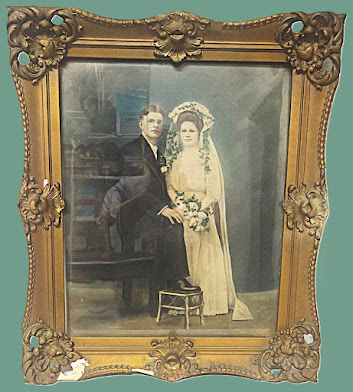
When it comes to couples, I’m fortunate to have photographs of my parents, my grandparents, all of my great-grandparents, and most of my second great-grandparents—some in multiple stages of life. But for this month’s “Couples” photo theme, I’ve chosen to feature a painting of my great-grandparents, Per and Elvera Johnson.
This portrait has held a place of honor in my family for generations. It once hung at the top of the staircase in my grandmother’s home—a daily reminder of her parents’ legacy. After her passing, it moved to my mother’s bedroom, where it remained until her death last year. Today, it continues its quiet watch in my home, a silent connection to the generations who came before me.
In 1919, Elvera, now a young mother of two, contracted tuberculosis. At the time, there was no cure for the disease—her only hope lay in a change of climate. So, like countless other's afflicted with the “White Plague,” they family moved west to Colorado, where the dry air, high altitude, and abundant sunshine were believed to offer the best chance of recovery. The family settled in Boulder, and Elvera was admitted to the Boulder Sanitarium, a respected health facility modeled after Dr. John Harvey Kellogg’s sanitarium back East.
Located at the base of Mount Sanitas and operated by the Seventh-day Adventist Church, the Boulder Sanitarium specialized in holistic treatments for respiratory diseases. Patients followed strict diets, received hydrotherapy, and spent long hours outdoors in the mountain air. While Elvera fought for her life, Per was left to care for their two young daughters with the help of Elvera’s sister, the girls’ Aunt Esther. It was a difficult and uncertain time for the family—emotionally, physically, and financially.
Sadly, Elvera died on February 12, 1920. She was just 31 years old. Her death left Per a widower with two small daughters. Eighteen months later, Aunt Esther also passed away, leaving two young children of her own.